
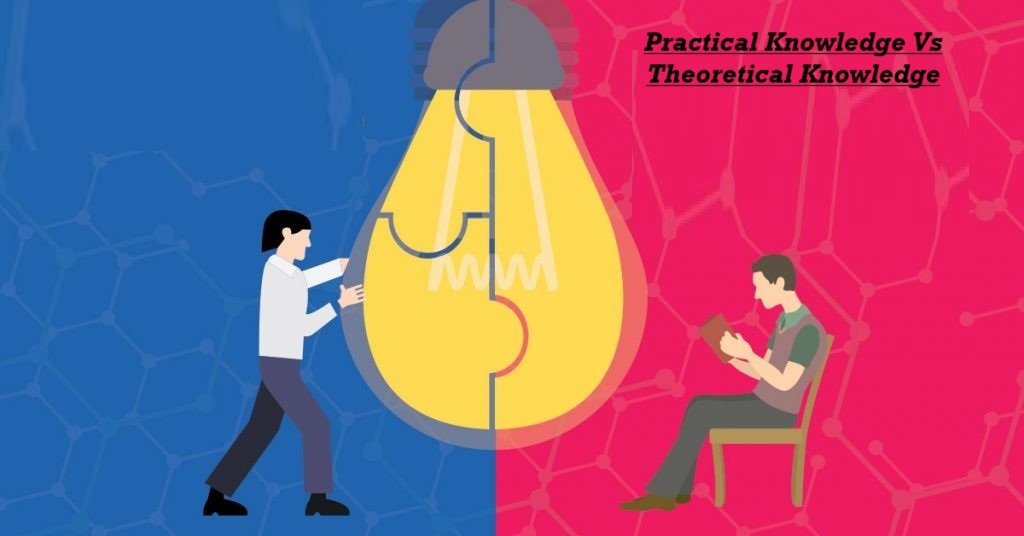
Introduction
Knowledge performs an crucial function in shaping a person’s character, schooling, profession, and everyday existence. It permits human beings to apprehend the world, treat problems, and make better choices. However, know-how isn’t always confined to studying books or attending school rooms. It moreover comes from private reports, experiments, education, and real-life experiences. This brings us to an interesting situation: practical knowledge vs theoretical expertise.
Both practical and theoretical information are crucial additions to gaining knowledge. Theoretical information allows people to understand ideas, thoughts, and facts, while practical expertise requires them to work in actual conditions; for example, a pupil may have a look at laptop programming thru textbooks, but writing and trying out actual code gives practical experience.
What Is Theoretical Knowledge?
Theoretical information refers to statistics, ideas, and knowledge material learned through books, lectures, research, classroom training and outstanding instructional materials.
It, in particular, makes a speciality of information about how something works and why a particular outcome occurs. Students normally develop theoretical information through educational subjects which includes arithmetic, technological expertise, facts, economics and computer technological know-how.
Examples of theoretical information:
- Learning mathematical components in a school room.
- Understanding scientific standards through textbooks.
- Studying grammar tips in advance of writing an essay.
- Learning the simple principles of computer programming.
- Understanding industrial employer control theories.
- Studying the core recommendations of physics and chemistry.
What is experiential knowledge?
Practical knowledge refers to the capability to use records, skills, and knowledge in actual lifestyles. It develops through hands-on practice, experiments, professional schooling, assertion, and personal experience.
Unlike theoretical expertise, practical knowledge specializes in doing something in choice to handiest understanding it.
For example, analyzing about cooking strategies can offer theoretical expertise, but getting prepared a meal in a kitchen develops sensible statistics.
READ ALSO: Indian Geography GK Questions and Answers: Important Questions for Competitive Exams
Examples of practical know-how:
- Driving a car after gaining knowledge of internet web page site visitors rules.
- Preparing food with the aid of following a recipe.
- Using computer software programs for expert artwork.
- Performing laboratory experiments.
- Repairing electric devices
- Managing an organization or handling customers.
- Learning communication abilities through real conversations.
Practical Knowledge vs Theoretical Knowledge: Important Differences
Practical expertise and theoretical information are related, but they have different uses and require different methods of mastering. Understanding their differences helps students and experts select out which kind of learning they want.
| Basis of Difference | Theoretical Knowledge | Practical Knowledge |
|---|---|---|
| Meaning | Knowledge of concepts and principles | Knowledge gained through experience |
| Learning Method | Books, lectures,and research | Practice, experiments and activities |
| Main Focus | Understanding how and why | Learning how to perform |
| Experience | Can be gained without direct experience | Usually requires hands-on experience |
| Application | Focuses on concepts and explanations | Focuses on real-life application |
| Learning Environment | Classrooms and libraries | Workshops, workplaces and laboratories |
| Skills | Analytical and conceptual skills | Technical and problem-solving skills |
| Examples | Studying driving rules | Driving a vehicle |
| Assessment | Written tests and examinations | Practical tests and demonstrations |
| Main Benefit | Builds a strong knowledge foundation | Develops confidence and working ability |
Importance of Theoretical Knowledge
Theoretical expertise is the foundation of education and professional development; without knowledge of essential principles, it could be tough to perform complex obligations efficaciously.
1. Builds a Strong Foundation
Theoretical knowledge permits understanding more principles earlier than using them. It creates a foundation that makes superior getting to know less complicated.
For instance, university college students analyzing engineering need to understand arithmetic, physics and technical princi,,ples in advance precisionprecisionigning machencouragetems.
2. Improves Critical Thinking
Reading, mastering and information precise standards encourages human beings to think logically. It permits them examine records, have a look at situations and growth significant conclusions.
Well-based supports Academic Development.
Schools, colleges, and universities offer theoretical knowledge via well-based instructional programmes. This know-how allows university college students prepare for examinations, competitive tests and professional qualifications.
4. Develops Problem-Solving Abilities
Theoretical principles help humans understand why problems occur. When human beings apprehend the ideas behind a particular scenario, they are able to find out suitable solutions.
5. Encourages Research and Innovation
Scientific discoveries and technological innovations often start with a theoretical mind. Researchers use current-day facts to amplify new theories, check possibilities and introduce upgrades.
Importance of Practical Knowledge
Practical information is similarly important because it teaches people to use their studies in real-world situations. It prepares humans for professional duties and real-world traumatic situations.
1. Improve everyday skills
Professional experience permits people increase competencies that are beneficial in everyday life and professional environments.
For instance, studying communication strategies is useful, but speaking with customers and colleagues improves actual verbal exchange talents.
2. Builds Confidence
It helps people feel more confident after they complete tasks and take on responsibilities themselves. Regular exercise facilitates real-life situations and makes them less complicated.
3. Develops Problem-solving Skills
Real-lifestyles conditions do now not constantly follow textbook examples. Practical revel in teaches humans a way to manage surprising issues and locate appropriate solutions.
4. Increases Employment Opportunities
Many employers look for candidates who can carry out professional responsibilities as opposed to depending only on educational qualifications.
5. Improves Decision-Making
Practical know-how teaches human beings ways to make picks based on real conditions. Experience allows them to recognize feasible risks and be aware of consequences.
Real-Life Examples of Practical Knowledge vs Theoretical Knowledge
The best manner to recognize the distinction between sensible knowledge and theoretical information is through everyday examples.
| Field | Theoretical Knowledge | Practical Knowledge |
|---|---|---|
| Education | Studying teaching methods | Teaching students in a classroom |
| Medicine | Learning about diseases | Examining and treating patients under supervision |
| Computer Science | Studying programming languages | Developing software applications |
| Cooking | Reading recipes | Preparing different dishes |
| Driving | Learning road safety rules | Driving a vehicle |
| Business | Studying management principles | Managing employees and customers |
| Engineering | Learning machine design concepts | Building and testing machines |
| Agriculture | Studying farming techniques | Growing crops in a field |
| Photography | Learning camera settings | Taking and editing photographs |
| Sports | Understanding game rules | Playing matches and practising skills |
Which Is More Important: Practical Knowledge or Theoretical Knowledge?
This is one of the most common questions among university students and specialists. The answer depends on the scenario, but neither sort of knowledge wants to be considered truly superior.
Theoretical statistics gives the information had to recognize a subject, at the identical time as realistic information lets in humans examine that statistics.
Practical experience desires practical knowledge- the way devices work. However, sensible revel in is essential to layout, carry out, check out and repair device.
Advantages and Disadvantages of Theoretical Knowledge
Theoretical learning has numerous benefits; however, it also has certain limitations.
Advantages:
- Provides true trouble records.
- Builds a strong instructional basis.
- Improves logical and analytical thinking
- Supports research and academic improvement.
- Helps novices recognize complicated concepts.
- Makes it easier to observe complex topics.
Disadvantages:
- May not provide enough real-world relevance
- Some minds may find it hard to understand without demonstrations.
- Excessive popularity of textbooks may additionally restrict hands-on abilities.
- Learners may also have difficulty applying standards in sudden conditions.
Advantages and Disadvantages of Practical Knowledge
Practical mastery lets people develop beneficial talents through direct involvement. However, it also has a few barriers.
Advantages:
- Improves technical and professional competencies.
- Builds self guarantee through normal exercise.
- Develops real-world problem-solving competencies.
- Helps people understand job requirements.
- Encourages impartial thinking
- Improves overall performance through enjoyment.
Disadvantages:
- Requires time and regular practice
- Some sensible activities may additionally involve monetary costs.
- Mistakes, soon, in the mind, or later, can create issues.
- Experience without proper theoretical information may also lead to incorrect options.
- Access to appropriate training facilities may be restricted.
How to Develop Both Practical and Theoretical Knowledge
Students and professionals must focus on growing each varieties of recognize-the way to advantage lengthy-term fulfillment.
1. Read Books and Educational Materials
Reading books, educational articles and academic sources facilitates assemble theoretical facts. Choose reliable analytical materials related to your difficulty or profession.
2. Participate in Practical Activities
Do not rely solely on studying. Participate in experiments, duties, workshops, and real-life sports to recognize how standards work.
3. Take Internships: Recognize workplace responsibilities and develop practical skills
Internships provide opportunities to work in expert environments. They assist cstudents to recognize workplace responsibilities and develop practical skillsollege college students recognize place of work responsibilities and growth sensible capabilities.
4. Learn Through Online Courses
Online instructional structures offer courses that integrate theoretical learning with practical assignments. Choose courses that provide assignments and demonstrations.
5. Work on Personal Projects
Personal taskwho are interested inwho are interested in mawayo use information independently. For example, university websites and training sites can help you learn about internet development and create their very personal websites to build programming abilities.
6. Learn From Experienced People
Teachers, running shoes and experts can percentage treasured information based totally on their stories. Observing their paintings through asking questions can enhance your know-how.
7. Practise Regularly
Practical competencies improve thru consistency. Regular workouts allow newbies to find mistakes, develop universal standards, and improve overall performance; it needs focus only
Role of Practical and Theoretical Knowledge in Education
Modern education need to now not interest excellent on examinations and textbook studying. Students moreover want opportunities to increase skills that prepare them for regular responsibilities and professional careers.
Schools and faculties can create a balanced analyzing surroundings with the aid of combining study room training with realistic sports activities.
Practical Knowledge vs Theoretical Knowledge in the Workplace
Both types of information are treasured in expert environmets employersnt personnel who understand their responsibilities and can whocompletesigned tasks effefficientlyheoretical information lets in employees recognize expert standards, at the same time as sensible experience allows them to perform their obligations.
For example, a virtual marketing and advertising professional might also recognise SEO, keywords,, nd on line advewebsitearnrunningrunningwever, dealbroadensh an real website, analysing website visitors and running campaigns, prprovides practicallnformation.
Conclusion
Practical expertise vs theoretical data is a crucial topic in education, personal improvement and professional life. Both forms of expertise make a contribution to gaining knowledge of specific techniques.
Theoredevelopwledge gives a basis ofthosethoseles, information and standards, even as realistic statistics develops the capability to use the ones standards in actual conditions. One lets humans apprehend statistics, and the opportunity teaches them a manner to use it successfully.
Students need to not depend certainly on textbooks, and specialists should now not forget about the significance of fundamental thoughts. A balanced studying technique that includes studying, studies, exercise, experiments and actual-global enjoy can produce better outcomes.
Frequently Asked Questions (FAQs)
1. What is the distinction between sensible expertise and theoretical know-how?
Theoretical knowledge refers to mastering mind, records, and requirements through books and training. Practical know-how refers to using that information through experience and hands-on practice.
2. Which is higher, practical information or theoretical knowledge?
Both are essential. Theoretical understanding provides a basis, while practical applications help people apply what they’veobserved in real-world sitssituations
3. What is an instance of theoretical know-how?
Learning mathematical components, reading clinical requirements, and understanding computer programming necessities are examples of theoretical understanding.
4. What is an example of practical knowledge?
Driving a car, making equipped mealpracticalalking equipment, and developing a pc software are examples of practical expertise.
5. Why is wise expertise critical for college students?
Practical information helps university students increase expert capabilities, enhance self notion, treatment actual-global problems and put together for destiny employment.
6. Can we gain practical understanding without theoretical know-how?
People can examine remarkable abilities via statement and experience, however theoretical information permits them perform obligations greater efficiently and efficiently.
7. How can university students decorate sensible and theoretical records collectively?
Students can integrate exam-room study with workshop responsibilities, laboratory experiments, workshops, online publications, and regular workouts
1 thought on “Practical Knowledge vs Theoretical Knowledge: Meaning, Differences, Importance, Examples and Benefits”